


Closed Lace vs Open Lace Toppers How They Look and Where to Place Them
A hair topper can be beautifully made and still look wrong if it sits in the wrong place. That happens often with closed lace and open lace toppers because they are built for different jobs.
Closed lace, also called a non-lace front topper, usually needs some natural hair left out at the front. Open lace, often called a lace front topper, is designed to help create the look of a front hairline. The difference is small on a product page, but very clear once the topper is on your head.
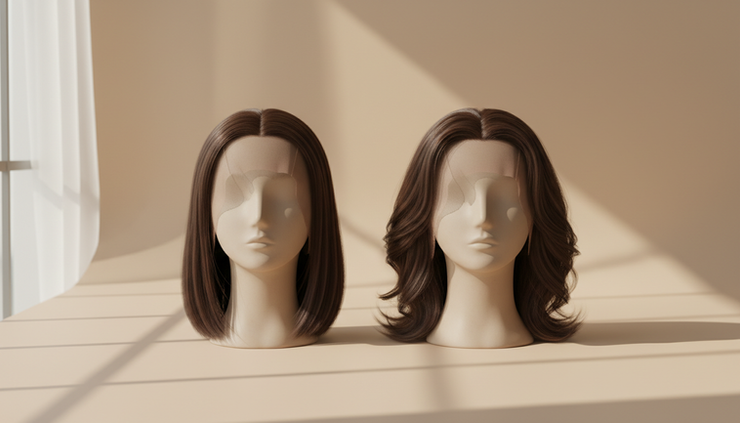
What a closed lace topper looks like
A closed lace topper has a finished front edge that is not meant to disappear into the skin the way a lace front does. The base may use lace, mono, silk, or another material, but the key point is the same: the front is closed rather than sheer and extended.
On the head, a closed lace topper usually looks best when the front edge is hidden under a small section of your own hair. That front hair creates the natural transition from forehead to topper.
A closed lace topper often gives:
A secure, easy fit
Good coverage through the crown or part line
A slightly fuller look near the front
Less need for trimming lace or using adhesive
A natural finish when blended behind existing front hair
The front edge may look more noticeable if it sits directly on the forehead or exactly at the hairline. That does not mean the topper is poor quality. It means it is being asked to do the job of a lace front.
Closed lace toppers work well when the front hairline is still present enough to blend. They are also helpful for people who wear bangs, curtain bangs, side-swept fronts, or soft face-framing pieces.
What an open lace topper looks like
An open lace topper has a sheer lace section at the front. Hair is usually tied into this lace in a way that lets the front look lighter and more scalp-like. This style is often called a lace front topper because the lace is meant to sit at the front hairline.
The goal is different from a closed lace topper. Open lace is made to reduce the need for front leave-out and give the illusion that hair is growing closer to the hairline.
An open lace topper can look especially natural when the hair is:
Brushed softly away from the face
Parted near the front
Styled without bangs
Worn with little or no front hair left out
Placed carefully along the natural hairline
The lace needs to suit the skin and the density needs to look believable. If the lace is too dark, too light, too shiny, or placed too low on the forehead, it can draw attention. A good lace front still needs careful placement.

The main difference is the front edge
The easiest way to compare the two is to look at what the front edge is supposed to do.
Feature | Closed lace topper | Open lace topper |
Front design | Finished, closed edge | Sheer lace front edge |
Best placement | Slightly behind natural front hair | At or slightly in front natural hairline |
Front hair needed | Usually yes | none |
Best for | Crown thinning, part thinning, blending with front hair | Frontal thinning, receding areas, swept-back styles |
Styling strength | Bangs and blended fronts | Exposed or lifted front hairlines |
Common mistake | Placing it too far forward | Placing it too low or too far back |
This is the heart of Closed Lace vs Open Lace Toppers How They Look and Where to Place Them: closed lace blends behind hair, while open lace helps build the look of a hairline.
Where to place a closed lace topper
Place a closed lace topper behind your natural front hairline, not directly on it. A good starting point is often just behind the area where your front hair still grows naturally. The exact distance depends on your haircut, density, and base size.
The front clips should anchor into your own hair without pulling. The topper should feel secure, but not tight. If it pulls backward or creates tension at the temples, shift it slightly or adjust the clips.
For the most natural closed lace placement:
Part your natural front hair forward.
Set the topper behind that front section.
Clip the front first, then the sides, then the back.
Blend your front hair over the topper’s front edge.
Style the front so the transition looks soft.
A closed lace topper often looks better with a little movement at the front. A flat, severe part can expose the edge. Soft bangs, layers, or a gentle side part can make the blend easier.
If the topper looks bulky at the front, it may be too far forward. If your natural front hair looks thin or separated, it may be too far back or need a different styling approach.

Where to place an open lace topper
Place an open lace topper just in front of the natural hairline. The lace front should meet the forehead in a way that follows the shape of your own hairline. It should not sit like a straight band across the forehead.
Many lace fronts have extra lace when new. That lace is usually trimmed before wearing. Trimming should follow the shape of the lace front without cutting too close to the knots. If the lace is cut too bluntly, the edge can become more visible.
For natural open lace placement:
Find your natural hairline shape.
Set the lace front along that line.
Check the temples before clipping everything down.
Secure the topper without stretching the lace.
Blend or smooth the front as needed.
Open lace can sit slightly in front of very sparse areas, but it should still look like a believable hairline. If it is too low, it can shorten the forehead and look wig-like. If it is too far back, your natural thinning area will show in front of the lace.
Some people use a small amount of tape, gel, or wig adhesive at the lace front. Others rely on clips only. The right choice depends on the topper design, comfort, skin sensitivity, lifestyle, and how exposed the front will be.
How to choose between them
Choose a closed lace topper if your front hairline is still strong enough to blend over an edge. It is often the easier everyday choice because it requires less lace work. It can be simple, secure, and very natural with the right cut.
Choose an open lace topper if the front hairline needs coverage or if you want to wear hair away from the face. It gives more styling freedom at the front, but placement must be more exact.
A few quick checks can help:
If you wear bangs most days, closed lace may be enough.
If you like a swept-back front, open lace may suit better.
If your thinning starts behind the hairline, closed lace may blend well.
If thinning affects the temples or front edge, open lace may look more natural.
If you want the lowest-maintenance option, closed lace is often simpler.
If you want the most realistic exposed hairline, open lace has the advantage.

A few fit signs to watch for
A well-placed topper should not need constant adjusting. It should feel balanced from front to back and side to side.
Signs a closed lace topper is misplaced include:
The front edge is visible
The topper starts too close to the forehead
The front looks thick or heavy
Your natural hair is not covering the edge
Signs an open lace topper is misplaced include:
The lace sits too low on the forehead
The lace line looks too straight
A gap shows between your hairline and the lace
The lace puckers because it is pulled too tightly
Small changes matter. Moving a topper even a little can change how natural the front looks.
The simple rule that makes placement easier
Think of the front construction before placing the topper.
A closed lace topper should usually sit behind your own front hair so your hair can hide and soften the edge. An open lace topper should sit at the hairline so the lace can create the front transition.
Once that difference is clear, choosing and placing a topper becomes much less confusing. The right base does not just add coverage. It works with the hair you have, the hairline you want, and the way you prefer to style your hair.
Jon Renau Instagram video
Closed lace (aka non–lace front) and open lace (lace front) toppers can look different and also have different placement. Take a look! 🖤


Comments